
Unite around a common plan
Create, edit and share flatplans
- 10-day free trial
- Instant access
- Unrestricted use
- Quick setup
- No obligation
- No credit card
Benefits for every department
Ensure every team member, in every department, in every location
has a real-time view of every issue
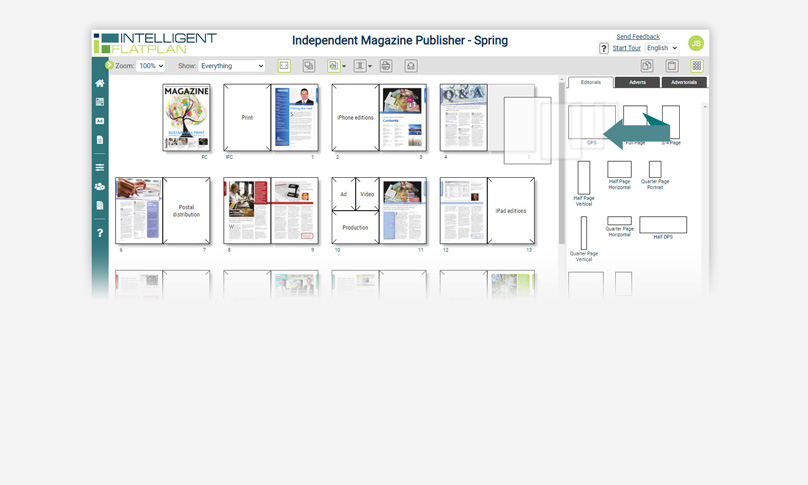
Drag and drop Objects
Quickly, easily and precisely drag and drop Objects onto Pages to allocate space for editorial content. Choose from a default set of commonly used shapes or add custom shapes specific to your Titles.
Colour-coded Workflow
Colour-coded Workflow lets everyone know where editorial content is in the production process, who owns it and whether it is ahead, on or behind schedule. Create bespoke Workflows to mirror existing production processes
Labels, Notes and Alerts
I am card slider Item content. Click here to edit this text. Lorem ipsum dolor sit amet, consectetur adipiscing elit. Ut elit tellus, luctus nec ullamcorper mattis, pulvinar dapibus leo.
What type of publishers use IF?
Intelligent Flatplan customers typically publish a portfolio of periodical magazine titles, often on a monthly frequency.
Advertising Slide 1
Every aspect of the Intelligent Flatplan is designed to be different, from concept to technology
Advertising Slide 2
Intelligent Flatplan customers typically publish a portfolio of periodical magazine titles, often on a monthly frequency.
Advertising Slide 3
The Intelligent Flatplan’s unique pricing policy automatically adjusts to any size of publisher.
Production 1
Every aspect of the Intelligent Flatplan is designed to be different, from concept to technology
Studio 1
Every aspect of the Intelligent Flatplan is designed to be different, from concept to technology
IT 1
Every aspect of the Intelligent Flatplan is designed to be different, from concept to technology
Management 1
Every aspect of the Intelligent Flatplan is designed to be different, from concept to technology
About us
Since 2007, Purelabs has dedicated itself to providing affordable,
easy-to-use, collaborative flatplanning tools

Our clients include

Customer since 2008
United Kingdom

Customer since 2008
New Zealand

Customer since 2008
United Kingdom

Customer since 2008
Australia
Meet the team
The management team's magazine publishing and software
development experience totals 70-years

Michelle
Customer Support

Max
Marketing

Jon
Founder

Simon
Engineering
Simple, transparent pricing
Pay-as-you-go
Typical pages per ISSUE:
Best for:
- Micro and small publishers
- Lower page count
- Fewer titles
- Fewer issues per year
Enterprise
Typical pages per YEAR:
Best for:
- Medium and large publishers
- Higher page counts
- Multiple titles
- Frequent issues per year
FAQs
A flatplan is a two-dimensional graphical representation of a publication, as if all the pages are laid flat (hence the term 'flatplan’). The simplest flatplans can be pencil sketches, while the most advanced take the form of collaborative project management tools: like the Intelligent Flatplan.
In complex, fast moving, deadline driven publishing environments, a flatplan provides a clear visual plan around which the whole team unites. For example, a 52-page monthly magazine could involve 1,000 individual workflow tasks every 20 working days. An interactive digital flatplan helps seamlessly guide the team through every one of those steps.
Three overarching benefits of digital flatplans are version control, real-time collaboration and mobility.
- There is only ever one version of a digital flatplan: the right one. This reduces confusion and avoidable errors
- Every time a workflow status changes, team members are immediately aware of the update. This improves productivity and teamwork
- Whether working from an office, home, client’s location or different country, every team member is working to a common plan. This reduces errors, improves productivity and underpins teamwork
Every aspect of the Intelligent Flatplan is designed to be different, from concept to technology. Here are some examples:
- Grassroots concept: Members of the Intelligent Flatplan’s development team also work as magazine publishing professionals. Everyday the team stress-tests the system in a live publishing environment, driving real-world feature development and refinement
- Fair pricing: From day one, our mantra was 'no publisher left behind’ regardless of size. The unique pricing model is based on pages published rather than users, company size or bank balance
- Technology innovation: Intelligent Flatplan world firsts include real-time, animated system updates (perfect for making collaborative flatplan updates) and an open API which lets publishers connect their flatplans to their advertisement management application
- Support: We publish a phone number for one-to-one conversations because we enjoy helping publishers get the most from the system and improve their production process
Intelligent Flatplan customers typically publish a portfolio of periodical magazine titles, often on a monthly frequency. However, the system is also employed for a wide array of publishing tasks. Here are some examples:
- Exhibition organisers manage the production on show guides
- Marketing agencies share the production progress of marketing publications, annual reports, etc with their clients
- Printers offer white-labelled versions of the system to their customers as a value-added service
- Directory publishers manage annual directories, often involving many hundreds of pages
- Contract publishers collaborate with their customer base
- Associations oversee the production of membership magazines
The Intelligent Flatplan’s unique pricing policy automatically adjusts to any size of publisher. A micro customer might publish a single, quarterly title comprising 32 pages, plus covers: 144 pages per year, while a large international customer could publish up to 100,000 pages per year.
Yes, customers can brand their account to provide a familiar environment.
- Add a company logo to the Home and Planning screens
- Add company and title logos to PDF printouts and advertisement booking confirmation forms
- Agencies and printers can 'white label’ the site. (Cost option)
There is no limit to users per account. To maximise the Intelligent Flatplan’s collaborative benefits we encourage users from the following departments as a minimum:
- Editorial
- Advertising sales
- Production
- Studio
- IT
- Management
The User Permissions capability lets account administrators allocate functions to match each user’s job role.
The Intelligent Flatplan features an integrated language capability. Starting late 2021 new languages will steadily be added based on demand.
Publishers working in more niche languages can 'jump the queue’ by forming a translation partnership with us.
One of the Intelligent Flatplan’s standout technical innovations is its real-time, multi-user, collaborative capability. Any number of users can simultaneously log into and work with multiple flatplans.
An 'anti-clash’ capability prevents one user’s actions impacting other users. For example, if a user moves an advert to another page, the advert is locked until the move is complete.
The Intelligent Flatplan’s real-time, animated update feature is a world-first. Changes made by one user are immediately presented to all other users as live animations. This feature is particularly useful if two or more users are making changes during a telephone meeting.
Also, if a user’s flatplan browser tab goes 'out of focus’ while they are working on other tasks, the next time the tab comes 'into focus’ the system will automatically check for changes and update the flatplan immediately.
There is no need to manually refresh a flatplan to see other users’ updates.
There’s no limit to the number of titles or issues per account. To maximise planning productivity, users are encouraged to setup at least 12-months’ worth of flatplans for each title.
Using this technique, users can add scheduled advertisements to their appropriate issues at the time of booking. Likewise, editors can allocate editorial space to articles at the time of commissioning.
User Permissions ensure users only see the titles they work on.
The Intelligent Flatplan’s pricing is like a mobile phone agreement but instead of purchasing minutes customers buy page credits. When a flatplan is activated for the first time, equivalent page credits are deducted from the account. A 36-page flatplan deducts 36 page credits.
Activated flatplans are free to use until the issue is published and the flatplan archived. Increasing a flatplan’s page count deducts an equal number of page credits. Note: Page credits are not refunded if a flatplan shrinks so we recommend starting flatplans at minimum page counts.
The Intelligent Flatplan’s two pricing models are designed to guarantee affordability for all sizes and types of publishing company.
- Pay-As-You-Go suits smaller publishers with fewer titles and smaller/less frequent issues. PAYG customers purchase page credits only when they start producing their next issue. PAYG page credits are purchased in batches of 50 or more. Price of a PAYG page credit is fixed at £0.35p.
- Enterprise suits larger publishers with more titles, issues and pages, starting at 1,000 page credits per year. Enterprise customers receive a year’s worth of page credits to prepare 12-months’ issues in advance. Payments can be made monthly, quarterly, or annually. Price of an Enterprise page credit starts at £0.25p each. Volume discounts apply.
Yes, a 30-day free trial is available for all potential customers, who we encourage to explore the system’s capabilities with their user group, including anyone adverse to digital tools.
One-to-many demo: Alongside the trial, potential customers are invited to a personalised, one-to-many, online demonstration, where their team can watch the Intelligent Flatplan in action and ask questions.
Competitor analysis: Adopting digital flatplanning is a significant decision for any publishing company, so we encourage potential customers to trial the Intelligent Flatplan alongside competitors to gain a fair comparison of the system’s features and benefits.
No, we don’t ask customers to sign a contract. We want customers to remain customers because they are happy using the system, not because they are tied to a contract. If a customer feels the system no longer meets their needs, they are free to leave.
Some of the Intelligent Flatplan’s earliest users have remained loyal customers for over 15-years.
- Pay-as-you-go customers purchase batches of page credits online via credit or debit card.
- Enterprise customers can spread payment for 12-month’s worth of page credits monthly, quarterly, or annually. Payment is via credit/debit card, direct debit, PayPal or invoice.
- Minimum batch of Pay-As-You-Go page credits is 50 @ £0.35 each, totalling £17.50 plus VAT.
- Minimum batch of Enterprise page credits is 1,000 @ £0.25 each, equating to £20.83 plus VAT per month. Volume discounts apply to Enterprise page credits as illustrated via the price calculator.
Customer support lies at the heart of the Intelligent Flatplan.
- Personalised, one-to-many, online demonstrations: Support staff guide users through the system’s features and functions, answering questions along the way.
- Telephone help desk: Call for a one-to-one conversation with a technician and/or publishing professional.
- Email help desk: Email questions for a prompt, documented reply.
- Send Feedback: Send questions, suggestions and bug reports from within the flatplanning screen.
- Step-by-step guides: Starting autumn 2021, the support team is introducing a catalogue of step-by-step guides.
- Video tutorials: Alongside the step-by-step guides, the support team is releasing a series of tutorial videos.
The support team operates a formal ticketing system to ensure feature requests and bug reports are professionally managed.
The support team is based in the city of Canterbury in the United Kingdom time zone.
Support hours are 9am to 5pm Monday to Friday, excluding UK public holidays.
The Support Area features a growing catalogue of tutorials. In addition to factual explanations of features and functions the tutorials also describe why feature were introduced and the benefits they offer publishers.
- Videos: Tutorial videos are produced in-house by the support team based on experience gained during testing and live magazine production. A number of video formats are offered including short-form, learning paths and detailed.
- Step-by-step: Mirroring the videos, the how-to guides offer step-by-step tutorials featuring written descriptions and annotated screenshots.
Yes. The support team’s favourite role is demonstrating the system live to individuals or groups of publishing professionals. Each demonstration can be tailored a customer’s specific requirements. Demonstrations are conducted via the 'join.me’ screen sharing and conference call application, so any number of people can attend.
To schedule a demonstration please contact the support team via email, telephone or the integrated Send Feedback facility.
Yes. The Intelligent Flatplan is under constant development, with updates applied several times a year. New features typically originate as direct customer requests or via the system’s daily stress tests.
To suggest a new feature, contact the support team by email, telephone or the integrated Send Feedback facility.
It depends. Every year is different. Our primary goals are security, reliability and performance so every update, no matter how small, is only applied after extensive inhouse and beta testing.
Typically the system is updated quarterly. Some changes, such as the introduction of new user-facing features will be obvious, while backend changes less so.
During a period where a significant upgrade is taking place (eg the migration from Flash to HTML), the upgrade schedule is extended to allow time for more testing.
The company is based in the city of Canterbury in the South East region of the United Kingdom. Canterbury is home to the University of Kent which supported the Intelligent Flatplan’s early development and commercialisation.
The South East region has a long consumer and B2B magazine publishing heritage and is home to some of the UK’s leading publishing companies.
Publishing Research Laboratories (Purelabs) was founded in 2007 and the Intelligent Flatplan SaaS application was launched at Publishing Expo in 2008.
The Intelligent Flatplan’s team has been involved in magazine publishing since 1987. Over that period it has been involved in the launch and management of over XX national and international titles.
Based on this experience the team offers a range of complementary services including:
- Mentoring
- Launch planning
- Contract editorial management
- Video production
- Bespoke software development
- Jon: Founder and managing director, Jon’s magazine publishing career started in 1987 as the technical editor of Eureka magazine, a specialist B2B title for design engineers. During the 'noughties’ Jon witnessed how the internet was fragmenting traditional publishing companies, saw demand for a collaborative magazine planning workspace, and the Intelligent Flatplan was born.
- Michelle: Company secretary, Michelle joined Purelabs at its launch in 2007. Michelle manages back-office operations including HR, accounting, marketing and, most importantly, one-to-one customer support.
- Simon: Lead developer, Simon laid down the first line of code in 2007 and has remained the lead developer ever since. Simon’s role includes code strategy, research and development, code design, debug and server operations.
- Max: Support, tutorials and training, Max is the newest team member, joining the company in 2021 on completion of his degree in Film Production. Max is spearheading the development of a portfolio of video based training and support resources. Alongside this, Max is using his experience as a radio producer to manage the company’s 'new media’ operations including social and podcasts.
At the time of writing, the Intelligent Flatplan is operating in 54 countries from the UK and USA to South Africa and New Zealand.
The Intelligent Flatplan application is hosted on a Rackspace server located in the United Kingdom.
At the time of writing the Intelligent Flatplan server has been operating continuously for over 16-years. During that period, total unplanned outages are measured in hours. Occasional planned maintenance is required for server hardware upgrades and software updates. Data is backed up every 60 minutes onsite and every 24 hours offsite. Processor load, RAM and drive capacity are monitored. System administrators subscribe to Rackspace’s 'Fanatical Support’ service.
Our research shows the magazine publishing industry is evenly split between PC and Mac. Thus, the Intelligent flatplan is designed and tested to work in browsers on both PC and Mac.
At the time of writing (2022) the Intelligent Flatplan application is not optimised for mobile devices. Firstly, a small mobile phone screen is not an ideal flatplanning environment. Secondly, users have not requested a mobile version. That said, the application could run on a mobile device and the development roadmap includes a mobile version with optimised feature set.
The Intelligent Flatplan has been tested in Chrome, Safari, Edge, Firefox, Explorer and Opera.
Comprehensive support
Less than 10% of our customers need to contact us about technical issues.
That's because our services are reliable and easy to use.
But, if you do need help, rest assured we have experts on hand 9-5pm every week day.
Call

Resource Centre
Over 90 per cent of customers who visit our support site find an answer here.